
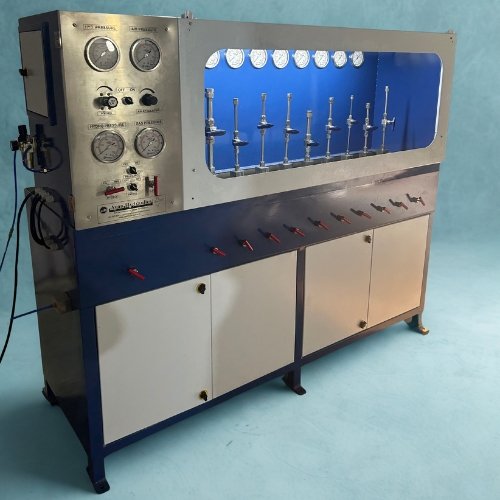
Testing Equipments Manufacturer in India
In today’s highly competitive industrial environment, quality is no longer an option but a necessity. Manufacturers across industries must ensure that their products meet strict quality standards, safety regulations, and performance requirements before reaching customers. Whether it is a valve, pipe, pressure vessel, automotive component, electrical equipment, or industrial machinery, every product must undergo proper inspection and testing to guarantee reliability and durability.
This is where Testing Equipments play a vital role. Testing equipment refers to specialized machines, instruments, and systems designed to evaluate the performance, strength, accuracy, safety, and functionality of products, materials, and components. These systems help manufacturers identify defects, verify compliance with industry standards, improve product quality, and reduce the risk of failures in real-world applications.
Today, testing equipment has become an essential part of manufacturing, research, quality control, maintenance, and product development processes across various industries.
What are Testing Equipments?
Testing equipments are instruments and machines used to inspect, measure, evaluate, and verify the characteristics of materials, components, and finished products.
Their primary purpose is to determine whether a product meets specified standards, technical requirements, and operational expectations.
Testing equipment can evaluate various parameters such as:
- Pressure
- Strength
- Hardness
- Leakage
- Durability
- Dimensional accuracy
- Electrical performance
- Material composition
- Functional performance
- Safety compliance
These systems help manufacturers maintain consistent product quality while minimizing defects and production errors.
Importance of Testing Equipments in Industry
Testing plays a critical role throughout the manufacturing and quality assurance process.
Ensures Product Quality
Testing helps verify that products meet design specifications and customer expectations.
Improves Safety
Defective products can create safety hazards. Testing identifies issues before products are used in the field.
Supports Regulatory Compliance
Many industries require mandatory testing to comply with national and international standards.
Reduces Production Defects
Testing helps detect manufacturing errors early in the production process.
Enhances Customer Satisfaction
Reliable and tested products improve customer confidence and brand reputation.
Minimizes Warranty Claims
Early defect detection reduces the likelihood of field failures and expensive warranty replacements.
How Testing Equipments Work
The operation of testing equipment depends on the specific application and testing method.
Generally, testing systems follow a structured process:
Sample Preparation
The component or product is prepared for testing.
Test Setup
The specimen is mounted or connected to the testing equipment.
Application of Test Conditions
The machine applies specific conditions such as pressure, force, temperature, voltage, or load.
Measurement and Monitoring
Sensors and instruments monitor product behavior during testing.
Result Analysis
Collected data is analyzed to determine whether the product meets required specifications.
Documentation
Test results are recorded for quality control and certification purposes.
Major Types of Testing Equipments
Pressure Testing Equipment
Used to verify the pressure resistance and leak-tightness of components.
Common applications include:
- Valves
- Pipes
- Pressure vessels
- Cylinders
- Tanks
Hydro Test Machines
Perform hydrostatic pressure testing using water as the testing medium.
Widely used in valve manufacturing and pipeline industries.
Valve Testing Machines
Specifically designed for testing industrial valves under hydraulic and pneumatic pressure conditions.
Tensile Testing Machines
Evaluate the mechanical strength and elongation properties of materials.
Commonly used in metal, plastic, and material testing laboratories.
Hardness Testing Equipment
Measures the resistance of materials to indentation and wear.
Popular hardness testing methods include:
- Rockwell
- Brinell
- Vickers
Leak Testing Equipment
Detects leakage in components and systems.
Widely used in automotive, aerospace, and industrial manufacturing.
Electrical Testing Equipment
Used to evaluate electrical performance, insulation resistance, voltage, and current characteristics.
Non-Destructive Testing Equipment
Allows inspection without damaging the product.
Includes:
- Ultrasonic Testing
- Magnetic Particle Testing
- Dye Penetrant Testing
- Radiographic Testing
Material Testing Equipment
Used to determine physical and mechanical properties of materials.
Industries That Use Testing Equipments
Manufacturing Industry
Ensures product quality and production consistency.
Oil and Gas Industry
Tests valves, pipelines, pressure vessels, and critical equipment.
Automotive Industry
Evaluates vehicle components and safety systems.
Aerospace Industry
Performs high-precision testing of aircraft components.
Power Generation Industry
Verifies equipment reliability and operational safety.
Chemical Industry
Tests pressure equipment and process components.
Construction Industry
Evaluates building materials and structural components.
Water Treatment Industry
Tests pipelines, valves, and storage systems.
Pharmaceutical Industry
Ensures equipment compliance and process validation.
Benefits of Modern Testing Equipments
Accurate Measurements
Advanced sensors provide highly reliable data.
Improved Product Quality
Helps manufacturers maintain strict quality standards.
Increased Productivity
Automated testing reduces manual inspection time.
Better Process Control
Continuous monitoring improves manufacturing consistency.
Reduced Operational Risks
Detects defects before products reach customers.
Enhanced Traceability
Digital records support quality audits and certifications.
Cost Savings
Preventing failures reduces repair and replacement expenses.
Key Features of Advanced Testing Equipments
Modern testing systems offer numerous advanced capabilities.
Digital Control Systems
Provide precise control over testing parameters.
PLC Automation
Enables automated testing sequences.
Touchscreen Interfaces
Simplify operation and data management.
Real-Time Monitoring
Displays live testing data and performance metrics.
Data Logging
Records test results for future analysis.
Report Generation
Creates professional quality assurance reports.
Remote Connectivity
Allows monitoring and diagnostics from remote locations.
Factors to Consider When Selecting Testing Equipments
Choosing the right testing equipment requires careful evaluation.
Application Requirements
Identify the specific testing objectives.
Testing Standards
Ensure compatibility with applicable industry standards.
Measurement Accuracy
Select equipment capable of delivering reliable results.
Automation Level
Consider manual, semi-automatic, or fully automatic systems.
Production Volume
Choose equipment suitable for expected testing workloads.
Maintenance Requirements
Evaluate long-term servicing and support needs.
Future Expansion
Consider future testing requirements and scalability.
Factors to Consider When Selecting Testing Equipments
Quality control departments rely heavily on testing equipment to maintain product consistency.
Testing systems help:
- Verify manufacturing accuracy
- Detect defects
- Validate design specifications
- Support certification processes
- Ensure regulatory compliance
Without proper testing, maintaining consistent product quality would be nearly impossible in modern manufacturing environments.
Emerging Trends in Testing Equipment Technology
Industrial testing is evolving rapidly with technological advancements.
Modern testing equipment now incorporates:
- Artificial Intelligence
- Machine Learning
- Automated Inspection Systems
- Industry 4.0 Integration
- Cloud-Based Data Storage
- Predictive Maintenance Analytics
- Smart Sensors
- IoT Connectivity
These technologies help improve testing accuracy, efficiency, and operational visibility.
Future of Industrial Testing Equipments
As industries continue to prioritize quality, safety, and efficiency, demand for advanced testing solutions will continue to grow.
Future testing systems will focus on:
- Greater automation
- Faster inspection cycles
- Enhanced accuracy
- Digital quality management
- Remote monitoring capabilities
- Sustainable testing practices
Manufacturers investing in modern testing equipment will gain significant advantages in productivity and product quality.
Conclusion
Testing Equipments are essential tools for ensuring product quality, safety, reliability, and compliance across various industries. From pressure testing and material analysis to electrical inspection and non-destructive evaluation, these systems play a crucial role in modern manufacturing and quality assurance processes.
Whether used in oil and gas, automotive, aerospace, construction, pharmaceuticals, or industrial manufacturing, testing equipment helps businesses deliver high-quality products while minimizing risks and operational costs. By investing in the right testing solutions, companies can improve efficiency, strengthen customer confidence, and maintain a competitive edge in today’s demanding marketplace.