
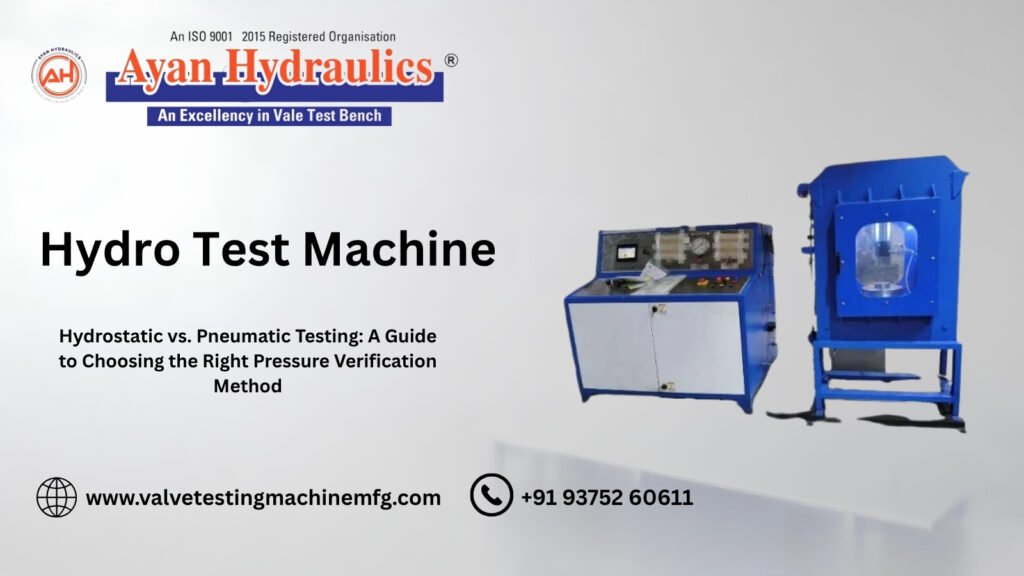
In industrial valve manufacturing, the final gatekeeper of quality is the pressure test. Whether you are testing a high-pressure gate valve or a custom-built hydraulic component, choosing between hydrostatic testing and pneumatic testing is a critical engineering decision.
Understanding the technical nuances of these two methods—and when to apply them—is essential for maintaining safety, precision, and compliance with global manufacturing standards.
1. Understanding Hydrostatic Testing (The Industry Standard)
Hydrostatic testing involves filling the valve or component with a liquid—typically water—and applying pressure to check for structural integrity and seat tightness.
Semantic Cluster: This method is often associated with Proof Pressure Testing, Volumetric Expansion, and Burst Pressure Analysis.
The Technical Edge: Because water is nearly incompressible, it stores very little elastic energy. If a structural failure occurs during a hydrostatic test, the energy release is minimal, making it the safest method for high-pressure bench testing.
Best Practice: When operating your Hydro Test Machine, ensure that all trapped air is purged. Even small air pockets can lead to inaccurate pressure readings due to the compressibility of gas within the test loop.
2. Deep Dive: Pneumatic Testing (The Gas-Based Protocol)
Pneumatic testing uses compressed gas—such as air, nitrogen, or helium—to pressurize the component.
Semantic Cluster: This method is linked to Bubble-Tight Leak Detection, Low-Pressure Seat Testing, and Gas-Phase Integrity.
When is it Required? Many industrial applications, especially in the chemical processing or cryogenic sectors, cannot tolerate even a trace of moisture. In these scenarios, pneumatic testing is mandatory to ensure the valve remains “dry” for the end-user.
The Safety Factor: Compressed gas stores significant potential energy. A failure under pneumatic load behaves like a rapid decompression event. This necessitates the use of Testing Equipments that include reinforced safety enclosures and remote-operated controls.
3. Critical Comparison: Choosing the Right Protocol
| Feature | Hydrostatic Testing | Pneumatic Testing |
| Primary Medium | Water / Glycol mix | Compressed Air / Nitrogen |
| Detection Method | Visual leak / Pressure drop | Bubble test / Pressure decay |
| Risk Profile | Low (Low energy release) | High (Requires blast protection) |
| Application | Heavy-duty pressure vessels | Clean/Dry service systems |
4. Semantic Integration: Powering Your Test Bench
Effective pressure testing isn’t just about the medium; it’s about the control system behind it.
Hydraulic Integration: A professional-grade testing bench often uses an integrated Hydraulic Power Pack to provide the necessary clamping force. By using a unified control system, you ensure that flange distortion is minimized, preventing false-positive leak results during the high-pressure phase.
Data-Driven Quality: Regardless of the media (water or gas), modern Valve Testing Machines must utilize digital pressure transducers. Search engines now prioritize content that discusses “traceability,” “calibration certification,” and “test logging”—features that our machines provide as standard.
5. Best Practices for Your Testing Facility
Safety Interlocks: Your test bench should feature mechanical interlocks that prevent pressurization unless the valve is fully clamped.
Environmental Impact: If your facility performs large-scale hydrostatic testing, consider an integrated filtration and recycling loop. This is a key metric in modern industrial manufacturing audits.
Standard Alignment: Always cross-reference your chosen testing protocol against the API, ASME, or MSS standards specific to your valve type.
Conclusion
Selecting between hydrostatic and pneumatic testing is a balance of safety requirements and application cleanliness. While hydrostatic testing remains the safest and most common choice for general manufacturing, pneumatic testing provides the necessary environment for specialized, dry-service industrial sectors.
Equip your facility with high-end machinery designed for both hydrostatic and pneumatic applications. View our full catalog of Testing Equipments here.