
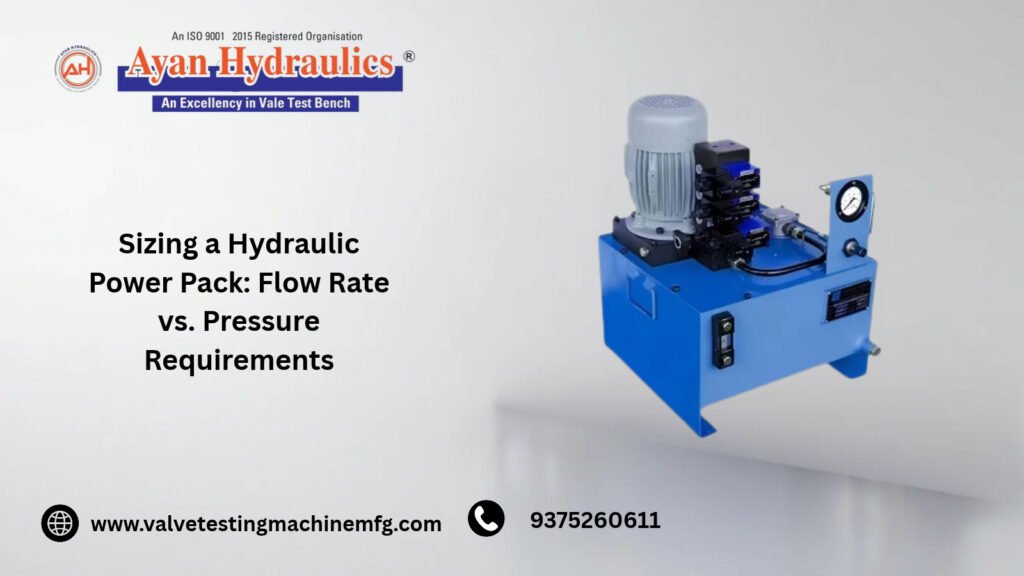
In industrial automation, heavy pressing, and custom machinery design, the hydraulic power pack serves as the beating heart of the system. It supplies pressurized fluid that drives cylinders, motors, and clamps. However, designing or selecting a power unit is not a guessing game.
If a power pack is improperly sized, your machinery will either crawl too slowly under load or suffer from chronic overheating and wasted energy. Sizing an industrial hydraulic power unit requires balancing two fundamental variables: pressure and flow rate.
1. Determining Required System Pressure (PSI or Bar)
Pressure dictates the amount of force your hydraulic actuators can exert. Before looking at motors or pumps, you must calculate the exact force required by your application.
The Basic Formula: Force ($F$) equals Pressure ($P$) multiplied by Area ($A$) ($F = P \times A$).
Calculating Required Pressure: If you know the maximum load your hydraulic cylinder needs to lift or press (e.g., a 20-ton press) and the effective surface area of the piston, you can determine the required operating pressure.
Adding Safety Margins: Always factor in system efficiency losses (typically 5% to 10% for pressure drops across valves, hoses, and manifolds). Size your maximum pump operating pressure slightly above your exact calculated requirement to ensure reliable performance.
2. Calculating Pump Flow Rate (GPM or LPM) for Actuator Speed
While pressure creates force, flow rate determines speed. How fast does your cylinder need to extend, or how quickly must your clamping fixture close?
Swept Volume and Speed: The flow rate delivered by the pump determines how many cubic inches or liters of fluid enter the actuator per minute.
The Sizing Rule: Larger cylinders or high-speed cycles require higher flow rates (measured in Gallons Per Minute or Liters Per Minute). If your flow rate is too low, your heavy machinery operations will drag; if it is too high, you risk generating excess heat and turbulence.
3. Selecting Electric Motor Horsepower (HP)
Once you have determined your peak pressure ($P$) and required flow rate ($Q$), you can calculate the electrical power required to drive the pump.
The Power Equation: Hydraulic horsepower is directly proportional to pressure multiplied by flow rate divided by a constant factor.
Motor Sizing: When choosing the electric motor horsepower (HP), always account for overall system efficiency (combining pump volumetric and mechanical efficiencies). Choosing a motor that is too small will cause it to stall under peak load, while an oversized motor wastes electrical energy.
4. Matching Reservoirs and Cooling Capacity
Sizing a power pack does not stop at the motor and pump. The reservoir tank and thermal management systems must match the circuit’s demands:
Storage Rule of Thumb: The oil reservoir capacity should typically be 3 to 4 times the pump’s per-minute flow rate to allow adequate time for fluid cooling and air bubble separation.
Internal Link Recommendation: To learn how to prevent thermal breakdown once your power pack is running continuously, read our guide on Preventing Oil Overheating in Continuous-Duty Hydraulic Power Systems. For specialized testing infrastructure, explore our main Valve Testing Machine product catalog.
Conclusion
Properly sizing a hydraulic power pack ensures that your industrial machinery operates with optimal efficiency, smooth cycle speeds, and reliable force generation. By carefully calculating pressure requirements, flow rates, and motor horsepower, you eliminate guesswork and build a robust fluid power system.
Need help sizing or custom-building a hydraulic power pack for your machinery? Contact our engineering team today to discuss custom flow rates, pressure configurations, and reliable power unit designs.