In the B2B industrial manufacturing and valve production sectors, product reliability is non-negotiable. Whether you supply valves to oil refineries, chemical processing plants, or water treatment facilities, your customers demand proof that every unit can withstand extreme pressures without failing. This is where international testing standards come in.
Navigating codes like API 598 and API 6D can sometimes be confusing for fabricators and quality control teams. Understanding the exact boundaries, test durations, and leakage criteria of each standard ensures your shop floor complies with global expectations and helps you select the correct Valve Testing Machine configured for the job.
What is API 598? (Scope and Inspection Requirements)
API 598 (Valve Inspection and Testing) is the most widely recognized standard for the inspection and pressure testing of industrial valves. It applies to a broad range of commonly used valve types, including:
Gate valves
Globe valves
Check valves
Ball valves
Plug valves
Butterfly valves
Key Testing Parameters under API 598:
Shell Test: Verifies the structural integrity of the valve body against pressure. The test pressure is typically 1.5 times the 100°F (38°C) rating.
Backseat Test: Performed on valves with backseats (like gate and globe valves) to ensure leakage does not occur through the packing chamber when the valve is fully open.
Seat Leakage Test: Measures how tightly the valve closes. API 598 defines precise allowable leakage rates using liquid or gas testing media depending on valve size and design.
What is API 6D? (Scope for Pipeline Valves)
API 6D (Specification for Pipeline Valves) is tailored specifically for the oil and gas pipeline sector. It governs the design, manufacturing, quality control, and testing of pipeline valves such as:
Pipeline slab gate valves
Axial gate valves
Ball valves
Check valves
Key Testing Parameters under API 6D:
While API 598 covers general industrial valves off-the-shelf, API 6D focuses on pipeline-specific demands.
Test Durations: API 6D often mandates longer hold times during hydrostatic shell and seat tests to account for the massive scale and high-pressure stakes of cross-country transmission lines.
Zero Leakage Expectations: For high-integrity pipeline ball and gate valves, acceptance criteria can be far stricter, often demanding zero visible leakage during extended seat test cycles.
Double Block and Bleed (DBB) Testing: API 6D includes specialized testing protocols for DBB and DIB (Double Isolation and Bleed) valves, requiring test rigs capable of isolating cavities and monitoring intermediate pressures.
Choosing the Right Testing Machine for API Compliance
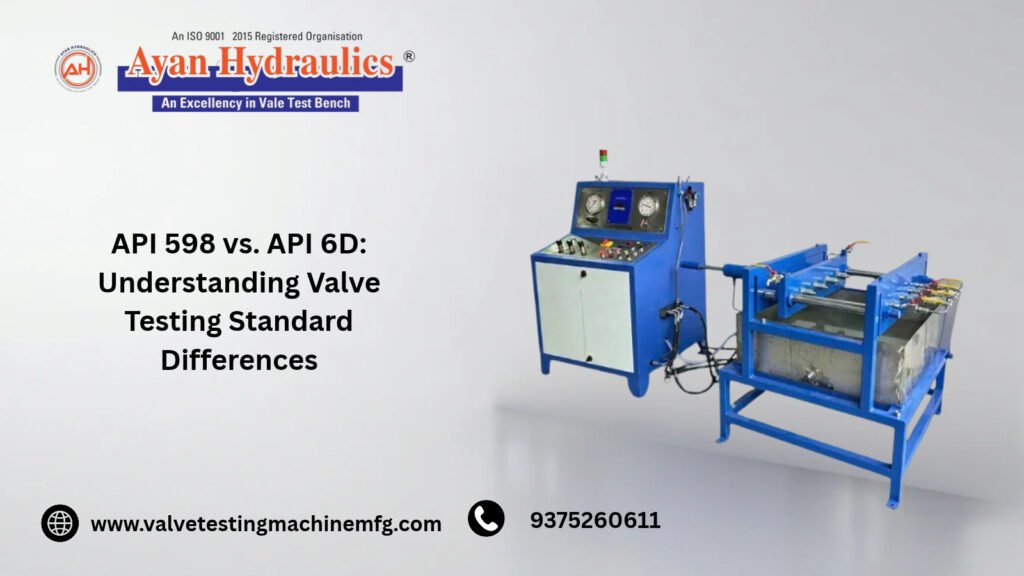
Meeting both API 598 and API 6D standards requires a robust, high-precision test rig. Standard manual bolting benches often fall short when dealing with high-pressure pipeline valves or high-volume production runs.
When investing in a testing rig, ensure your equipment features:
Adjustable Hydraulic Clamping: To secure flanged or welded valves securely without inducing body distortion.
Dual-Mode Capabilities: Ability to perform both hydrostatic water testing and low-pressure pneumatic seal testing.
Data Logging Integration: Digital pressure transducers that record test duration and pressure decay curves for compliance certificates.
Internal Link Recommendation: To learn more about how precise clamping prevents body distortion during testing, read our related guide on Design Considerations for Multi-Station Valve Testing Benches. If your facility also requires pressure verification for auxiliary piping, explore our heavy-duty Hydro Test Machine solutions.
Conclusion
Understanding whether your production line falls under API 598 or API 6D dictates everything from your test pressures to your clamping fixture design. By aligning your testing protocols with these recognized international standards, you guarantee safety, satisfy global auditors, and reinforce your reputation as a trusted valve manufacturer.
Looking for an API-compliant Valve Testing Machine or Hydro Test Bench tailored to your manufacturing facility? Contact our engineering team today to discuss custom pressure ratings, automated clamping options, and digital data logging integration for your shop floor.