
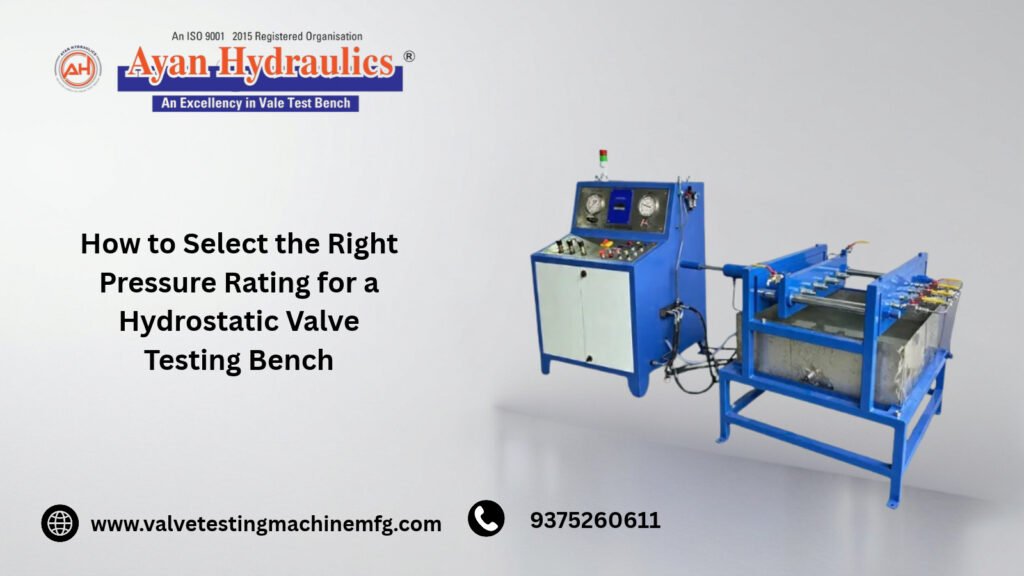
When investing in capital equipment for your manufacturing plant, choosing the correct specifications is critical. For valve manufacturers and repair facilities, the test bench is the final gatekeeper of quality. If a hydrostatic valve testing bench is under-specified, you risk being unable to test high-pressure industrial valves, leading to bottlenecks, compliance failures, or worse—equipment breakdown under high load.
Selecting the right pressure rating requires more than just picking the highest number available. It involves understanding valve pressure classes, design margins, and pump capabilities.
1. Determining Maximum Allowable Working Pressure (MAWP)
Before looking at test benches, you must analyze the range of valves your facility produces or services.
Valve Pressure Classes: Valves are typically rated by ASME classes (e.g., Class 150, 300, 600, 900, 1500, or 2500) or PN ratings (PN16, PN40, up to PN400).
Calculating MAWP: The Maximum Allowable Working Pressure of the valve dictates the baseline pressure your test bench must achieve. For instance, a Class 600 valve has a much higher working pressure than a standard Class 150 valve, requiring a test rig capable of handling heavier hydraulic loads.
2. Understanding Test Pressure Margins (Shell vs. Seat Testing)
International standards (such as API 598 or ASME standards) dictate strict multiples for testing pressures compared to the valve’s cold working pressure rating:
Shell Test Pressure: Typically performed at 1.5 times the 100°F (38°C) pressure rating of the valve. Your testing bench must be able to sustain this elevated pressure without structural stretch or seal failure.
Seat Test Pressure: Usually performed at 1.1 times the 100°F rating for high-pressure checks, or supplemented with low-pressure pneumatic air testing for bubble-tight seat verification.
Example: If you manufacture valves rated up to 100 sterile bar (approx. 1500 PSI), your testing machine’s shell test capability must comfortably exceed 150 bar (approx. 2250 PSI) with a safe operational margin.
3. Sizing Pumps and Hydraulic Clamping Forces
A high-pressure rating is useless if the machine cannot clamp the valve securely against that pressure. As test pressure increases, the hydraulic force pushing against the valve end-flanges multiplies exponentially.
Clamping Force Calculation: The upward thrust force equals the test pressure multiplied by the internal area of the valve port opening. Your test bench’s hydraulic clamping cylinders must generate enough counter-force to keep the valve sealed without distorting the body.
Pump Selection: Ensure the integrated hydro test pump can ramp up pressure smoothly without dangerous pressure spikes. Multi-stage or air-driven booster pumps offer precise control during high-pressure ramps.
4. Customization Options for High-Pressure Industrial Valve Test Rigs
Every manufacturing floor has unique needs. When ordering a custom testing machine, consider future-proofing your pressure thresholds:
Modular Pressure Ranges: Opt for dual-circuit setups where low-pressure testing uses high-flow pumps for fast filling, and high-pressure testing switches to precision low-flow boosters.
Digital Pressure Relief Valves: Protect your operators and test specimens with programmable pressure cut-offs that prevent accidental over-pressurization.
Internal Link Recommendation: To ensure your testing facility complies with safety standards when dealing with high pressures, read our related guide on Safety Interlocks and Relief Protections in Automated Valve Testing Rigs. If you also need standalone testing for pipelines or vessels, explore our specialized Hydro Test Machine line.
Conclusion
Selecting the right pressure rating for your hydrostatic valve testing bench protects your investment, ensures compliance with global standards, and keeps your shop floor safe. Always evaluate your highest valve class, apply standard 1.5x test margins, and ensure your clamping mechanism matches the thrust load.
Unsure what pressure rating or clamping capacity your production line requires? Contact our engineering team today to discuss custom specifications, dual-range pumping units, and robust valve testing machine designs built for your exact manufacturing needs.