
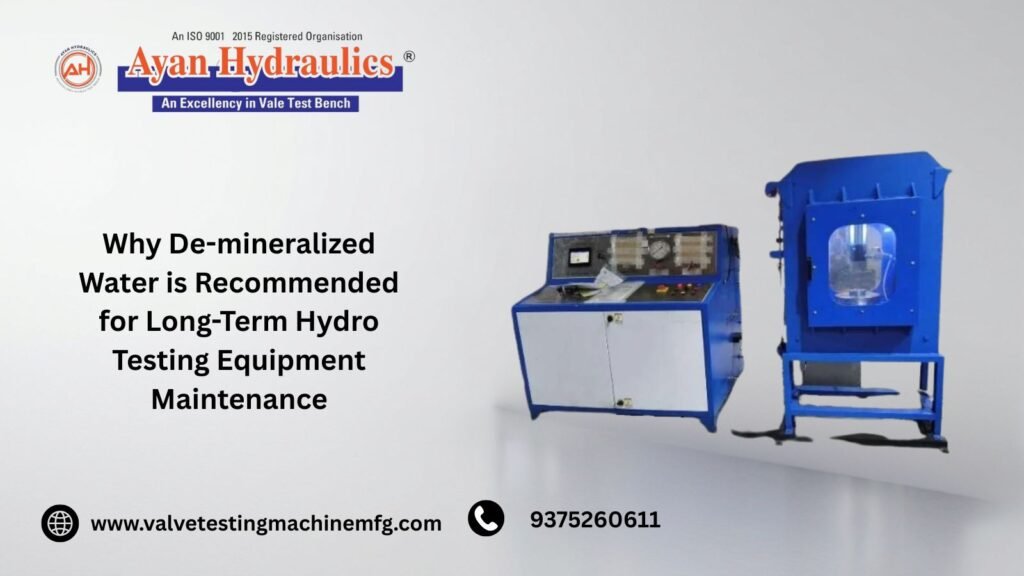
When investing in robust testing systems, plant operators often focus heavily on pump ratings, pressure manifolds, and digital data loggers. However, one of the most critical factors influencing the long-term reliability of your equipment is often overlooked: the quality of the water used during testing.
Using untreated tap or borewell water may seem convenient, but it introduces hidden minerals that can silently degrade your high-pressure systems. Implementing demineralized (DM) water is a vital practice for extending the operational life of any professional hydro testing setup.
The Hidden Dangers of Using Raw Tap or Borewell Water
Raw water naturally contains dissolved salts, calcium, magnesium, and other mineral solids. When used repeatedly in a high-pressure testing environment, these minerals cause severe operational issues:
Scale Accumulation and Clogging: As water pressures rise and flow through narrow valves, regulators, and check valves, minerals precipitate out of solution, forming hard scale deposits that choke internal channels.
Electrochemical Corrosion: Dissolved chlorides and ions in raw water accelerate rust and pitting on stainless steel manifolds, pump cylinders, and internal pipe circuits.
Seal and Plunger Degradation: Suspended microscopic particles and hard mineral crystals act as an abrasive paste against high-pressure plunger seals and packing, leading to premature leakage and seal failure.
What is Demineralized Water and How Does It Protect Machinery?
Demineralized water (often referred to as DM water) is water that has had almost all of its mineral ions—such as sodium, calcium, iron, copper, and chloride—removed through specialized ion-exchange resins or reverse osmosis systems.
Zero Scaling Potential: Without dissolved minerals, there is no solid residue left behind when pressure drops or when equipment dries out after a test cycle.
Extended Component Lifespan: High-pressure plunger pumps, precision check valves, and digital pressure sensors operate smoothly without abrasive particle wear.
Cleaner Test Objects: Using pure water ensures that the internal cavities of the valves or pressure vessels being tested are not contaminated with mineral residues or salt films post-test.
Best Practices for Water Management in Hydro Testing Plants
To maximize the ROI on your testing infrastructure, incorporate these water management protocols into your daily operations:
Use Dedicated Storage Tanks: Keep a dedicated supply of filtered or demineralized water rather than pulling directly from erratic raw water sources.
Implement Closed-Loop Filtration: If water is recycled during production testing, install sediment and micron filters alongside a deionization unit to catch debris continuously.
Routine Flushing: Flush testing benches with clean water or a mild corrosion inhibitor solution at the end of a shift if testing involves intermittent exposure to reactive fluids.
Conclusion & Call to Action
Protecting your investment means looking after every variable—starting with the fluid flowing through your pumps. Using demineralized water keeps your maintenance costs low and your testing accuracy high.
Looking for resilient testing hardware? Discover robustly built Testing Equipments designed for reliable, long-term industrial operations.