
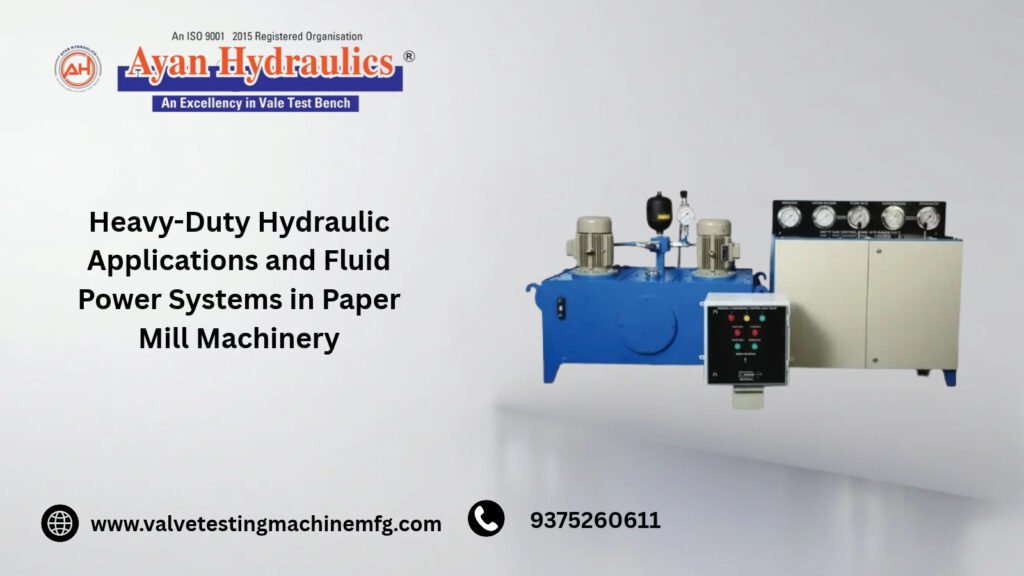
Paper manufacturing is an intense, continuous industrial process where massive machinery operates 24 hours a day, 7 days a week. From the high-speed wet end where wood pulp fibers are formed into a wet web, to the massive press sections and calender stacks, tremendous mechanical force is required to squeeze out moisture and finish the paper sheet.
Delivering this continuous, reliable power requires specialized paper mill machinery engineered with robust hydraulic power units capable of withstanding moisture, heat, and round-the-clock operation.
1. Key Hydraulic Systems Across the Papermaking Process
Fluid power plays a vital role in controlling and driving critical sections of a paper mill:
Press Section Nip Loading: Massive hydraulic cylinders apply precise, uniform linear pressure across top and bottom press rolls. This controlled force squeezes out millions of gallons of water, directly reducing thermal drying energy costs.
Forming Fabric and Felt Tensioning: Hydraulic tensioners maintain exact, constant tension on delicate forming fabrics and synthetic felts, preventing tracking errors, wrinkles, and premature wear at high line speeds.
Reel Winders and Unwind Stands: Smooth proportional hydraulic braking and positioning controls manage heavy finished paper rolls during high-speed rewinding operations without tearing the web.
2. Surviving the Harsh Paper Mill Environment
Hydraulic systems installed in pulp and paper mills face environmental challenges unlike almost any other industrial sector:
High Humidity and Spray: Water vapor and wet pulp spray saturate the ambient air around wet-end machinery, requiring corrosion-resistant reservoirs, sealed electrical enclosures, and moisture-absorbing breathers.
Continuous Thermal Management: Operating 24/7 generates substantial oil heat. Power units must be equipped with efficient air-cooled or water-cooled heat exchangers to maintain optimal fluid viscosity.
3. Engineering Reliability into Mill Power Units
To prevent catastrophic downtime, paper mill hydraulic systems incorporate advanced engineering safeguards:
Duplex Filtration Loops: Continuous-duty filtration systems with differential pressure indicators allow filter elements to be swapped out on the fly without shutting down production.
Variable Displacement Pumping: Modern energy-efficient pumps match output flow precisely to operational demand, minimizing heat generation and electricity consumption during holding cycles.
Internal Link Recommendation: To learn how valves controlling these fluid lines are certified, read our guide on Valve Testing Machines for Paper Mill Machinery: Ensuring Zero-Leakage in Pulp Lines. For specialized testing infrastructure, explore our main Valve Testing Machine product catalog.
Conclusion
Paper mill machinery relies heavily on robust fluid power systems to maintain high-speed, continuous production. By prioritizing corrosion protection, advanced filtration, and precise pressure control, manufacturers ensure maximum uptime and efficiency in pulp processing plants.
Looking for custom-engineered hydraulic power units and fluid power systems designed specifically for paper mill machinery? Contact our engineering team today to discuss reliable industrial solutions for your facility.